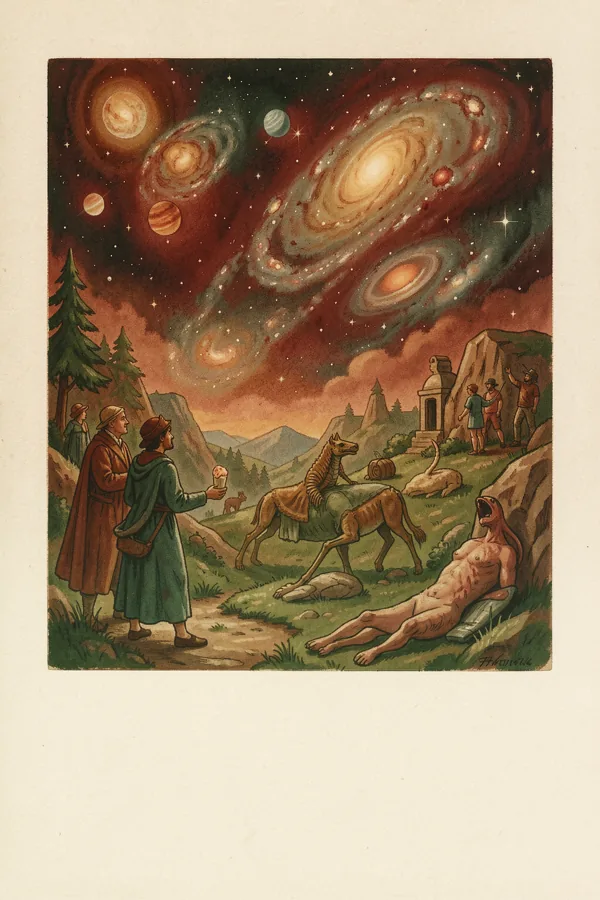
Vestiges of the Natural History of Creation is an 1844 scientific treatise, published anonymously, that presents a sweeping narrative of cosmic and biological evolution. It traces a law of development from the formation of stars and planets to the emergence of life and humankind, and is a key precursor to Darwinian thought. Worth listening to for its influential, controversial vision of a self-developing natural world.
For teachers and schools: paste the code into your site or blog.
Cover illustration generated by AI.
Text source: gutenberg.org · The work is in the public domain.
Opening of the book
Transcribed from the 1844 John Churchill edition by David Price, email [email protected] VESTIGES OF THE NATURAL HISTORY OF CREATION. LONDON: JOHN CHURCHILL, PRINCES STREET, SOHO. M DCCC XLIV. CONTENTS. PAGE The Bodies of Space—Their arrangements and formation 1 Constituent materials of the Earth and of the other Bodies of Space 27 The Earth formed—Era of the Primary Rocks 44 Commencement of Organic Life—Sea Plants, Corals, etc. 54 Era of the Old Red Sandstone—Fishes abundant. 66
Secondary Rocks. Era of the Carboniferous Formation.—Land formed—Commencement of Land Plants 76 Era of the New Red Sandstone—Terrestrial Zoology commences with Reptiles—First traces of Birds 94 Era of the Oolite—Commencement of Mammalia 105 Era of the Cretaceous Formation 116 Era of the Tertiary Formation—Mammalia abundant 125 Era of the Superficial Formations—Commencement of present Species 134 General Considerations respecting the Origin of the Animated Tribes 145 Particular Considerations respecting the Origin of the Animated Tribes 165 Hypothesis of the Development of the Vegetable and Animal Kingdoms 191 Macleay System of Animated Nature—This System considered in connexion with the Progress of Organic Creation, and as indicating the natural status of Man 236 Early History of Mankind 277 Mental Constitution of Animals 324 Purpose and General Condition of the Animated Creation 361 Note Conclusory 387 THE BODIES OF SPACE, THEIR ARRANGEMENTS AND FORMATION. It is familiar knowledge that the earth which we inhabit is a globe of somewhat less than 8000 miles in diameter, being one of a series of eleven which revolve at different
 Readnara