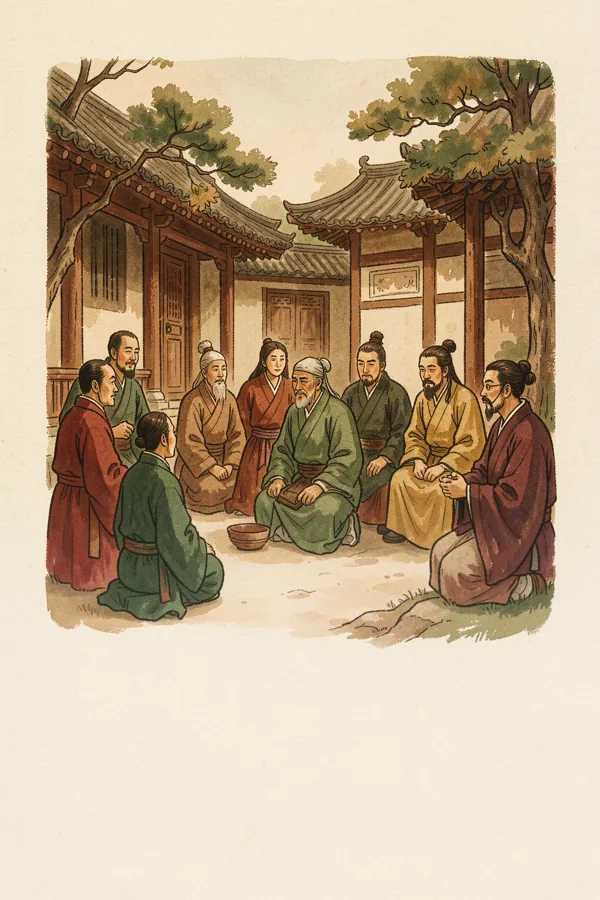
Opening of the book
Book I
HǪƗLj R
I
The Master said, “Is it not pleasant to learn with a constant perseverance and application?
“Is it not delightful to have friends coming from distant quarters?
“Is he not a man of complete virtue, who feels no discomposure though men may take no note of him?”
II
The philosopher Yû said, “They are few who, being filial and fraternal, are fond of offending against their superiors. There have been none, who, not liking to offend against their superiors, have been fond of stirring up confusion.
“The superior man bends his attention to what is radical. That being established, all practical courses naturally grow up. Filial piety and fraternal submission! —are they not the root of all benevolent actions?”
III
The Master said, “Fine words and an insinuating appearance are seldom associated with true virtue.”
IV
The philosopher Tsǎng said, “I daily examine myself on three points: —whether, in transacting business for others, I may have been not faithful; —whether, in intercourse with friends, I may have been not sincere; —whether I may have not mastered and practised the instructions of my teacher.”
V
The Master said, “To rule a country of a thousand chariots, there must be reverent attention to business, and sincerity; economy in expenditure, and love for men; and the employment of the people at the proper seasons.”
VI
The Master said, “A youth, when at home, should be filial, and, abroad, respectful to his elders. He should be earnest and truthful.
He should overflow in love to all, and cultivate the friendship of the good. When he has time and opportunity, after the performance of these things, he should employ them in polite studies.”
Keep listening free
 Readnara