The third volume of the memorial edition of Francis Maitland Balfour's works, comprising the second volume of his Treatise on Comparative Embryology, devoted to the Vertebrata. It surveys the developmental history of the Chordata and then moves through systematic embryology and organogeny. A careful nineteenth-century scientific work for readers interested in the foundations of embryology.
For teachers and schools: paste the code into your site or blog.
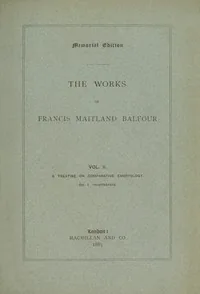
Cover of the original edition (Project Gutenberg, public domain).
Text source: gutenberg.org · The work is in the public domain.
Opening of the book
THE WORKS OF FRANCIS MAITLAND BALFOUR. VOL. III. Memorial Edition. Cambridge: PRINTED BY C. J. CLAY, M.A. AND SON, AT THE UNIVERSITY PRESS. Memorial Edition. THE WORKS OF FRANCIS MAITLAND BALFOUR, M.A., LL.D., F.R.S., FELLOW OF TRINITY COLLEGE, AND PROFESSOR OF ANIMAL MORPHOLOGY IN THE UNIVERSITY OF CAMBRIDGE. EDITED BY M. FOSTER, F.R.S., PROFESSOR OF PHYSIOLOGY IN THE UNIVERSITY OF CAMBRIDGE; AND ADAM SEDGWICK, M.A., FELLOW AND LECTURER OF TRINITY COLLEGE, CAMBRIDGE.
VOL. III. A TREATISE ON COMPARATIVE EMBRYOLOGY. Vol. II. Vertebrata. London: MACMILLAN AND CO. 1885 [The Right of Translation is reserved.] PREFACE TO VOLUME II. The present volume completes my treatise on Comparative Embryology. The first eleven chapters deal with the developmental history of the Chordata. These are followed by three comparative chapters completing the section of the work devoted to Systematic Embryology. The remainder of the treatise, from Chapter XIV. onwards, is devoted to Organogeny. For the reasons stated in the introduction to this part the organogeny of the Chordata has been treated with much greater fulness than that of the other groups of Metazoa. My own investigations have covered the ground of the present volume much more completely than they did that of the first volume; a not inconsiderable proportion of the facts recorded having been directly verified by me. The very great labour of completing this volume has been much lightened by the assistance I have received from my friends and pupils. Had it not been for their co-operation a large number of the disputed points, which I have been able to investigate during the preparation of the work, must have been left untouched. My special thanks are due to Mr Sedgwick, who has not only
 Readnara