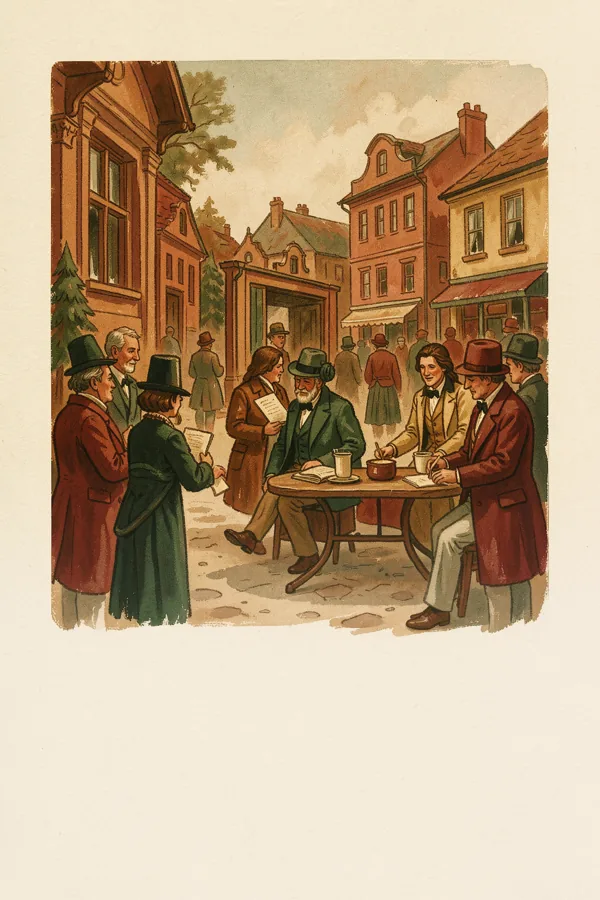
The Theory of the Leisure Class is a work of economic and social essays. Thorstein Veblen examines how societies develop a leisure class that marks status through conspicuous leisure and consumption rather than productive work. Worth listening for its influential analysis of social rituals and economic behavior.
For teachers and schools: paste the code into your site or blog.
Cover illustration generated by AI.
Text source: gutenberg.org · The work is in the public domain.
Opening of the book
THE THEORY OF THE LEISURE CLASS by Thorstein Veblen Contents Chapter One ~~ Introductory The institution of a leisure class is found in its best development at the higher stages of the barbarian culture; as, for instance, in feudal Europe or feudal Japan. In such communities the distinction between classes is very rigorously observed; and the feature of most striking economic significance in these class differences is the distinction maintained between the employments proper to the several classes. The upper classes are by custom exempt or excluded from industrial occupations, and are reserved for certain employments to which a degree of honour attaches. Chief among the honourable employments in any feudal community is warfare; and priestly service is commonly second to warfare. If the barbarian community is not notably warlike, the priestly office may take the precedence, with that of the warrior second. But the rule
 Readnara