The Secrets of the Self (Asrar-i Khudi) — A Philosophical Poem
Muhammad, Sir Iqbal
Poetry
Book language: English
85 pages
The Secrets of the Self (Asrar-i Khudi) is a philosophical poem by Sir Muhammad Iqbal, translated from Persian by Reynold A. Nicholson. It explores the cultivation of the self, spiritual awakening, and the strengthening of individual identity through poetic reflection. It is worth listening to for its blend of mystical, philosophical, and ethical themes.
For teachers and schools: paste the code into your site or blog.
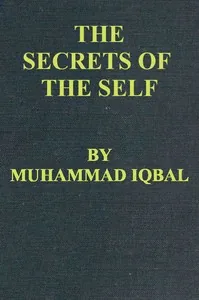
Cover of the original edition (Project Gutenberg, public domain).
Text source: gutenberg.org · The work is in the public domain.
Opening of the book
THE SECRETS OF THE SELF (ASRÁR-I KHUDÍ)
Publisher Logo MACMILLAN AND CO., Limited LONDON · BOMBAY · CALCUTTA · MADRAS MELBOURNE THE MACMILLAN COMPANY NEW YORK · BOSTON · CHICAGO DALLAS · SAN FRANCISCO THE MACMILLAN CO. OF CANADA, Ltd. TORONTO
THE SECRETS OF THE SELF (ASRÁR-I KHUDÍ) A PHILOSOPHICAL POEM BY SHEIKH MUHAMMAD IQBAL OF LAHORE TRANSLATED FROM THE ORIGINAL PERSIAN WITH INTRODUCTION AND NOTES BY REYNOLD A. NICHOLSON, Litt.D., LL.D. LECTURER ON PERSIAN IN THE UNIVERSITY OF CAMBRIDGE MACMILLAN AND CO., LIMITED ST. MARTIN’S STREET, LONDON 1920 COPYRIGHT
CONTENTS PAGE Contents v Introduction vii Prologue 1 I. Showing that the system of the universe originates in the Self, and that the continuation of the life of all individuals depends on strengthening the Self 16 II. Showing that the life of the Self comes from forming desires and bringing them to birth 23 III. Showing that the Self is strengthened by Love 28 IV. Showing that the Self is weakened by asking 38 V. Showing that when the Self is strengthened by Love it gains dominion over the outward and inward forces of the universe 43 VI. A tale of which the moral is that negation of the Self is a doctrine invented by the subject races of mankind in order that by this means they may sap and weaken the character of their rulers 48 VII. To the effect that Plato, whose thought has deeply influenced the mysticism and literature of Islam, followed the sheep’s doctrine, and that we must be on our guard against his theories 56 VIII. Concerning the true nature of poetry and the reform of Islamic literature 60 IX. Showing that the education of the Self has three stages: Obedience, Self-control, and Divine Vicegerency 72 X. Setting forth the inner meanings of the names of Ali 85
 Readnara