Opening of the book
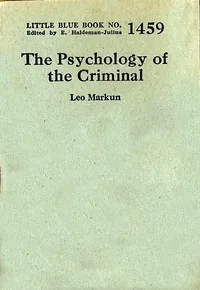
LITTLE BLUE BOOK NO.
Edited by E. Haldeman-Julius 1459
The Psychology of
the Criminal
Leo Markun
HALDEMAN-JULIUS PUBLICATIONS
GIRARD, KANSAS
Copyright, 1929,
Haldeman-Julius Company
PRINTED IN THE UNITED STATES OF AMERICA
THE PSYCHOLOGY OF THE
CRIMINAL
THE NATURE OF THE PROBLEM
Let us define a criminal as a person who has committed a crime, whether or not he is known as such. A crime, according to Austin and
Stephen, is “an act or omission that the law punishes.” Perhaps this definition does not sufficiently set apart crimes from torts and violations of contract, for which penalties payable to individuals are provided. I prefer to think of a crime as an act or omission which is punishable after public prosecution.
It is a crime to spit on the floor in certain places, it may be one to drive an automobile around the corner at a speed higher than eight miles an hour. There are many parts of the United States where mocking at the name of Jesus Christ constitutes the crime of blasphemy. It is also a crime to kill a man who refuses to hold up his hands to permit his pockets to be rifled, or to give aid and comfort to the enemy of the country of which the offender is a citizen.
In our wide sense of the word, crime is extremely common. There can be little doubt that, among the normal adults now resident in the
United States, the criminals outnumber the non-criminals. It does not affect the argument that many men and women have violated the law without so much as being aware of the fact: ignorance, according to an old rule, is no defense.
Moreover, it is not extremely rare and unusual to be arrested. Many minor offenders are summoned to court instead of being lodged in jail while awaiting trial, but usage in this respect is not at all consistent.
Especially since the automobile has become popular, receiving a summons and having to pay a fine have lost their power to confer ignominy, except as they imply lack of influence with the local politicians.
Keep listening free
 Readnara