A series of epistolary essays in which Blaise Pascal, writing under a pseudonym, defends the Jansenist theologian Antoine Arnauld and critiques the moral theology and casuistry of the Jesuits. They are valued for their clear, ironic prose and their passionate argument about conscience, power, and religious authority.
For teachers and schools: paste the code into your site or blog.
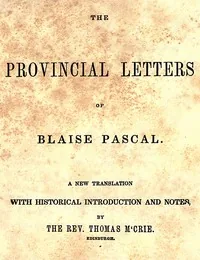
Cover of the original edition (Project Gutenberg, public domain).
Text source: gutenberg.org · The work is in the public domain.
Opening of the book
THE
PROVINCIAL LETTERS
OF
BLAISE PASCAL.
A NEW TRANSLATION
WITH HISTORICAL INTRODUCTION AND NOTES,
BY
THE REV. THOMAS M‘CRIE.
EDINBURGH.
If my letters are condemned at Rome, that which I condemn in them is condemned in heaven.—PĵǪŕĵƯ.
NEW YORK:
ROBERT CARTER & BROTHERS No. 530 BROADWAY. 1856.
CONTENTS. PAGE Pǡŧżĵŕŧ, vii HƗǪǵLjǡƗŕĵƯ IƿǵǡLjŠǼŕǵƗLjƿ, ix LETTER I. Disputes in the Sorbonne, and the invention of proximate power—a term employed by the Jesuits to procure the censure of M. Arnauld, 63 LETTER II. Of sufficient grace, which turns out to be not sufficient—Concert between the Jesuits and the Dominicans—A parable, 76 Reply of “the Provincial” to the first two Letters, 88 LETTER III. Injustice, absurdity, and nullity of the censure on M. Arnauld—A personal heresy, 90
LETTER IV. Actual grace and sins of ignorance —Father Bauny’s Summary of sins, 100 LETTER V. Design of the Jesuits in establishing a new system of morals—Two sorts of casuists among them—A great many lax and some severe ones—Reason of this difference—Explanation of the doctrine of probabilism— A multitude of modern and unknown authors substituted in the place of the holy fathers— Escobar, 116 LETTER VI. Various artifices of the Jesuits to elude the authority of the gospel, of councils, and of the popes—Some consequences resulting from their doctrine of probability—Their relaxations in favor of beneficiaries, of priests, of monks, and of domestics— Story of John d’Alba, 135 LETTER VII.
 Readnara