This is volume three of Hegel's lectures on aesthetics, part of his systematic philosophy of art. It examines the particular arts—architecture, sculpture, painting, music, and poetry—as forms through which the Idea manifests historically. Listeners interested in philosophy, art theory, and the development of aesthetic thought will find it rewarding.
For teachers and schools: paste the code into your site or blog.
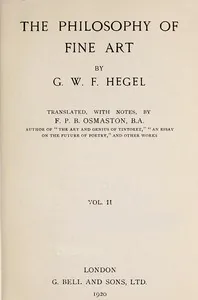
Cover of the original edition (Project Gutenberg, public domain).
Text source: gutenberg.org · The work is in the public domain.
Opening of the book
THE PHILOSOPHY OF FINE ART BY G. W. F. HEGEL TRANSLATED, WITH NOTES, BY F. P. B. OSMASTON, B.A. AUTHOR OF "THE ART AND GENIUS OF TINTORET," "AN ESSAY ON THE FUTURE OF POETRY," AND OTHER WORKS VOL III LONDON G. BELL AND SONS, LTD. 1920 CONTENTS OF VOL. III THIRD PART THE SYSTEM OF THE PARTICULAR ARTS INTRODUCTION [Summary. Nature of the relation between the system of Art-types, or the collective totality of ideal world-
presentments, and their objective realization in independent works of art. Nature of the process in the evolution of the specific arts themselves, and of the aspects identical in all. The origins of art. Grace, Charm, and severe or agreeable Style] 3 DIVISION OF THE SUBJECT [The principle of differentiation as determined by the sensuous aspect of the subject-matter, and the relation thereto of the human senses of Sight, Hearing, and intellectual Conception. Insufficiency of such a principle of classification. Alternative principle discussed and illustrated of more concrete nature, in which the evolution of truth as the reality of the Idea itself is presented] 14 SUBSECTION I ARCHITECTURE INTRODUCTION [Of the beginnings of human art, and that of building in particular. Of the nature of the subordinate classification of architecture viewed as symbolic, classical and romantic] 25 Division of Subject 26 CHAPTER I INDEPENDENT AND SYMBOLIC ARCHITECTURE Introduction and Subdivision 32 1. Works of architecture erected in order to unite peoples 36 2. Works of architecture intermediate between the arts of building and sculpture 38
 Readnara