This second volume of Hegel’s lectures on fine art is philosophical essays on aesthetics. It traces the ideal through symbolic, classical, and romantic art, focusing on symbolic art and the symbol. Listeners interested in how Hegel relates artistic form to spiritual meaning will find it rewarding.
For teachers and schools: paste the code into your site or blog.
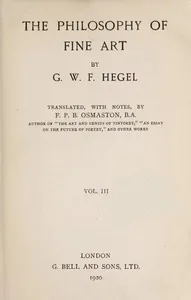
Cover of the original edition (Project Gutenberg, public domain).
Text source: gutenberg.org · The work is in the public domain.
Opening of the book
THE PHILOSOPHY OF FINE ART BY G. W. F. HEGEL TRANSLATED, WITH NOTES, BY F. P. B. OSMASTON, B.A. AUTHOR OF "THE ART AND GENIUS OF TINTORET," "AN ESSAY ON THE FUTURE OF POETRY," AND OTHER WORKS VOL II LONDON G. BELL AND SONS, LTD. 1920 CONTENTS OF VOL. II SECOND PART INTRODUCTION [Evolution of the Ideal in the Particular Types of Fine Art, namely, the Symbolic, the Classical, and the Romantic. Symbolic Art seeks after that unity of ideal
significance and external form, which Classical art in its representation of substantive individuality succeeds in securing to sensuous perception, and which Romantic art passes beyond, owing to its excessive insistence on the claims of Spirit] SUBSECTION I THE SYMBOLIC TYPE OF ART INTRODUCTION OF THE SYMBOL GENERALLY [1. Symbol as a sign simply in language, colours, etc. 8 2. Not a mere sign to represent something else, but a significant fact which presents the idea or quality it symbolizes 9 3. Thing symbolized must have other qualities than that accepted as symbol. Term symbol necessarily open to ambiguity 10 (a) Ambiguity in particular case whether the concrete fact is set before us as a symbol. Difference between a symbol and a simile. Illustrations 10 (b) Ambiguity extends to-entire worlds of Art, e.g, Oriental art. Two theories with regard to mythos discussed and contrasted 14 (c) The problems of mythology in the present treatise limited to the question, "How far symbolism is entitled to rank as a form of Art?" Will only consider symbol in so far as it belongs to Art in its own right and itself proceeds from the notion of the Ideal, the unfolding of which it commences] 19 DIVISION OF SUBJECT [1. The artistic consciousness originates in wonder. The effects that result from such a state. Art the first interpreter of the religious consciousness.
 Readnara