A concise guide to English usage and composition by Cornell professor William Strunk Jr. It sets out elementary rules of grammar, punctuation, and paragraphing, with brief examples and principles for clear prose. Worth listening to for its practical advice on writing directly and carefully.
For teachers and schools: paste the code into your site or blog.
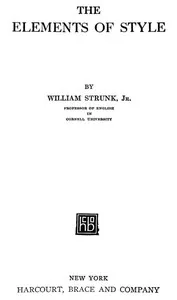
Cover of the original edition (Project Gutenberg, public domain).
Text source: gutenberg.org · The work is in the public domain.
Opening of the book
Transcriber's Notes:
Every effort has been made to replicate this text as faithfully as possible, including inconsistencies in spelling and hyphenation.
Some corrections of spelling and punctuation have been made.
They are marked like this in the text. The original text appears when hovering the cursor over the marked text. A list of amendments is at the end of the text.
THE
ELEMENTS OF STYLE
BY
WILLIAM STRUNK, Jr.
PROFESSOR OF ENGLISH
IN
CORNELL UNIVERSITY
NEW YORK
HARCOURT, BRACE AND COMPANY
COPYRIGHT, 1918, 1919, BY
WILLIAM STRUNK, JR.
COPYRIGHT, 1920, BY
HARCOURT, BRACE AND HOWE, INC.
THE MAPLE PRESS YORK PA
CONTENTS Page I. Introductory 5 II. Elementary Rules of Usage 7 1. Form the possessive singular of nouns by adding 's 7 2. In a series of three or more terms with a single conjunction, use a comma after each term except the last 7 3. Enclose parenthetic expressions between commas 8 4. Place a comma before a conjunction introducing a co-ordinate clause 10 5. Do not join independent clauses by a comma 11 6. Do not break sentences in two 12 7. A participial phrase at the beginning of a sentence must refer to the grammatical subject 13 III. Elementary Principles of Composition 15 8. Make the paragraph the unit of composition: one paragraph to each topic 15 9. As a rule, begin each paragraph with a topic sentence; end it in conformity with the beginning 17 10. Use the active voice 19 11. Put statements in positive form 21 12. Use definite, specific, concrete language 22 13. Omit needless words 24 14. Avoid a succession of loose sentences 25 15. Express co-ordinate ideas in similar form 26 16. Keep related words together 28 17. In summaries, keep to one tense 29 18. Place the emphatic words of a sentence at the end 31 IV. A Few Matters of Form 33 V. Words and Expressions Commonly Misused 36 VI. Spelling 48 VII. Exercises on Chapters II and III 50
 Readnara