Æsthetic as science of expression and general linguistic
Benedetto Croce
Essays
Book language: English
507 pages
Benedetto Croce's essay collection sets out his philosophy of aesthetics, arguing that intuition and expression are identical and that art is a form of intuitive knowledge. It also treats language as expression and connects aesthetics with general linguistics. Listeners interested in philosophy, art theory and language will find a systematic, influential argument.
For teachers and schools: paste the code into your site or blog.
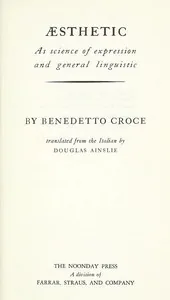
Cover of the original edition (Project Gutenberg, public domain).
Text source: gutenberg.org · The work is in the public domain.
Opening of the book
ÆSTHETIC As science of expression and general linguistic BY BENEDETTO CROCE translated, from the Italian by DOUGLAS AINSLIE THE NOONDAY PRESS A division of FARRAR, STRAUS, AND COMPANY 1920 THE ÆSTHETIC IS DEDICATED BY THE AUTHOR TO THE MEMORY OF HIS PARENTS PASQUALE AND LUISA SIPARI AND OF HIS SISTER MARIA
CONTENTS
EXTRACT FROM INTRODUCTION xix
NOTE BY THE TRANSLATOR xxv
AUTHOR'S PREFACE xxvii
I
THEORY OF ÆSTHETIC
I 1
INTUITION AND EXPRESSION
Intuitive knowledge—Its independence with respect to intellectual knowledge—Intuition and perception—Intuition and the concepts of space and time—Intuition and sensation—Intuition and association—
Intuition and representation—Intuition and expression—Illusion as to their difference—Identity of intuition and expression
II 12
INTUITION AND ART
Corollaries and explanations—Identity of art and intuitive knowledge
—No specific difference—No difference of intensity—The difference is extensive and empirical—Artistic genius—Content and form in
Æsthetic—Criticism of the imitation of nature and of the artistic illusion—Criticism of art conceived as a fact of feeling, not a theoretical fact—Æsthetic appearance, and feeling—Criticism of the theory of æsthetic senses—Unity and indivisibility of the work of art
—Art as liberator
III 22
ART AND PHILOSOPHY
Inseparability of intellectual from intuitive knowledge—Criticism of the negations of this thesis—Art and science—Content and form: another meaning—Prose and poetry—The relation of first and second degree—Non-existence of other forms of cognition—Historicity—Its
 Readnara