Proverbs of All Nations, Compared, Explained, and Illustrated
Walter K. Kelly
Essays
Book language: English
232 pages
Proverbs of All Nations, Compared, Explained, and Illustrated is a nineteenth-century collection of essays by Walter K. Kelly. It gathers proverbs from many countries, comparing their meanings and uses in ordinary speech. Listeners can enjoy a wide survey of folk wisdom and the ways different cultures express similar ideas.
For teachers and schools: paste the code into your site or blog.
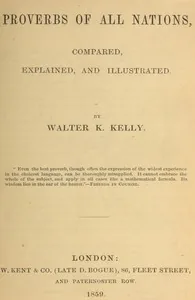
Cover of the original edition (Project Gutenberg, public domain).
Text source: gutenberg.org · The work is in the public domain.
Opening of the book
PROVERBS OF ALL NATIONS.
PROVERBS OF ALL NATIONS,
COMPARED,
EXPLAINED, AND ILLUSTRATED.
BY
WALTER K. KELLY.
"Even the best proverb, though often the expression of the widest experience in the choicest language, can be thoroughly misapplied. It cannot embrace the whole of the subject, and apply in all cases like a mathematical formula. Its wisdom lies in the ear of the hearer."—
FǡƗŧƿŠǪ Ɨƿ CLjǼƿŕƗƯ.
LONDON:
W. KENT & CO. (LATE D. BOGUE), 86, FLEET STREET,
AND PATERNOSTER ROW.
1859.
WINCHESTER:
PRINTED BY HUGH BARCLAY,
HIGH STREET.
PREFACE.
EƿƄƯƗǪƒ ƯƗǵŧǡĵǵǼǡŧ, in most departments the richest in Europe, is yet the only one in which there has hitherto existed no comprehensive collection of proverbs adapted to general use. To supply this deficiency is the object of the present attempt.
Dean Trench, in the preface to his "Proverbs and their Lessons," adverts to "the immense number and variety of books bearing on the subject;" but adds, that among them all he knows not one which appears to him quite suitable for all readers. "Either," he says, "they include matter which cannot fitly be placed before all—or they address themselves to the scholar alone; or, if not so, are at any rate inaccessible to the mere English reader—or they contain bare lists of proverbs, with no endeavour to compare, illustrate, or explain them— or, if they do seek to explain, they yet do it without attempting to sound the depths or measure the real significance of that which they attempt to unfold."
My own experience in this department of literature is entirely in
 Readnara