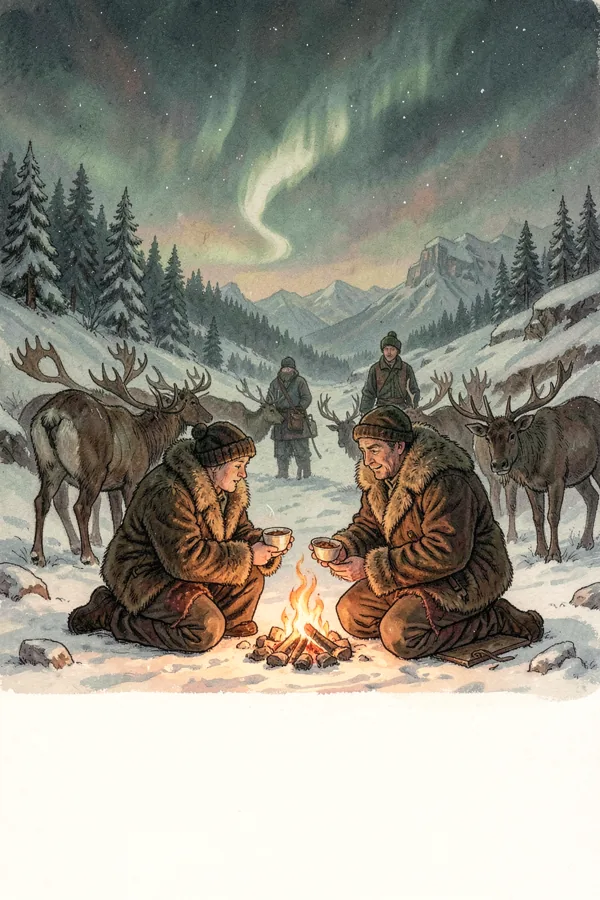
Peter Kropotkin's Mutual Aid is a collection of essays on cooperation and mutual support in animal and human societies. Drawing on his travels in Siberia and Manchuria, Kropotkin argues that mutual aid, not only competition, has been a vital factor in evolution and survival. It offers a historical counterpoint to one-sided Darwinism and a case for solidarity.
Two aspects of animal life impressed me most during the journeys which I made in my youth in Eastern Siberia and Northern
Manchuria. One of them was the extreme severity of the struggle for existence which most species of animals have to carry on against an inclement Nature; the enormous destruction of life which periodically results from natural agencies; and the consequent paucity of life over the vast territory which fell under my observation. And the other was, that even in those few spots where animal life teemed in abundance, I failed to find —although I was eagerly looking for it — that bitter struggle for the means of existence, among animals belonging to the same species, which was considered by most Darwinists
(though not always by Darwin himself) as the dominant characteristic of struggle for life, and the main factor of evolution.
The terrible snowstorms which sweep over the northern portion of Eurasia in the later part of the winter, and the glazed frost that often follows them; the frosts and the snowstorms which return every year in the second half of May, when the trees are already in full blossom and insect life swarms everywhere; the early frosts and, occasionally, the heavy snowfalls in July and August, which suddenly destroy myriads of insects, as well as the second broods of the birds in the prairies; the torrential rains, due to the monsoons, which fall in more temperate regions in August and September —resulting in inundations on a scale which is only known in America and in Eastern
Asia, and swamping, on the plateaus, areas as wide as European
States; and finally, the heavy snowfalls, early in October, which eventually render a territory as large as France and Germany, absolutely impracticable for ruminants, and destroy them by the thousand —these were the conditions under which I saw animal life struggling in Northern Asia. They made me realize at an early date the overwhelming importance in Nature of what Darwin described as “the natural checks to over-multiplication,” in comparison to the
 Readnara