John Dewey's critical exposition of Leibniz's New Essays Concerning the Human Understanding examines Leibniz's response to Locke's Essay, treating knowledge, innate ideas, and the mind. It is a clear guide to early modern philosophy, useful for anyone interested in how two major thinkers differ.
For teachers and schools: paste the code into your site or blog.
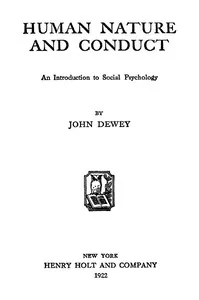
Cover of the original edition (Project Gutenberg, public domain).
Text source: gutenberg.org · The work is in the public domain.
Opening of the book
Transcriber’s Notes: Every effort has been made to replicate this text as faithfully as possible, including inconsistencies in spelling and hyphenation. Some corrections of spelling and punctuation have been made. They are marked like this in the text. The original text appears when hovering the cursor over the marked text. A list of amendments is at the end of the text. GERMAN PHILOSOPHICAL CLASSICS FOR ENGLISH READERS AND STUDENTS. EDITED BY GEORGE S. MORRIS. LEIBNIZ’S NEW ESSAYS CONCERNING THE HUMAN UNDERSTANDING. LEIBNIZ’S NEW ESSAYS CONCERNING THE HUMAN UNDERSTANDING. A CRITICAL EXPOSITION. By JOHN DEWEY, Ph.D.,
ASSISTANT PROFESSOR OF PHILOSOPHY IN THE UNIVERSITY OF MICHIGAN, AND PROFESSOR (ELECT) OF MENTAL AND MORAL PHILOSOPHY IN THE UNIVERSITY OF MINNESOTA CHICAGO: SCOTT, FORESMAN AND COMPANY 1902 Copyright, 1888, By S. C. Griggs and Company. PREFACE. The purpose of the series of which the present volume is one, is not, as will be seen by reference to the statement in the initial volume, to sum up in toto the system of any philosopher, but to give a “critical exposition” of some one masterpiece. In treating the “Nouveaux Essais” of Leibniz, I have found myself obliged, at times, to violate the letter of this expressed intention, in order to fulfil its spirit. The “Nouveaux Essais,” in spite of its being one of the two most extended philosophical writings of Leibniz, is a compendium of comments, rather than a connected argument or exposition. It has all the suggestiveness and richness of a note-book, but with much also of its fragmentariness. I have therefore been obliged to supplement my account of it by constant references to the other writings of Leibniz, and occasionally to take considerable liberty with the order of the treatment of topics. Upon the whole, this book will be found, I hope, to be a faithful reflex not only of Leibniz’s thought, but
 Readnara