English Surnames: Their Sources and Significations
Charles Wareing Endell Bardsley
Essays
Book language: English
879 pages
English Surnames: Their Sources and Significations is a nineteenth-century essay collection by Charles Wareing Endell Bardsley. It explores how English family names arose and what they mean, grouping them by origins such as patronymics, nicknames, and other categories. Listeners interested in language, local history, and genealogy will find it a thoughtful guide to the stories carried by ordinary surnames.
For teachers and schools: paste the code into your site or blog.
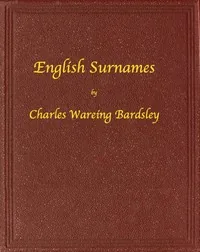
Cover of the original edition (Project Gutenberg, public domain).
Text source: gutenberg.org · The work is in the public domain.
Opening of the book
The cover image was created by the transcriber and is placed in the public domain.
ENGLISH SURNAMES.
LONDON: PRINTED BY
SPOTTISWOODE AND CO., NEW-STREET SQUARE
AND PARLIAMENT STREET
ENGLISH SURNAMES:
THEIR
SOURCES AND SIGNIFICATIONS.
BY
CHARLES WAREING BARDSLEY, M.A.
SECOND EDITION, REVISED AND ENLARGED
London:
CHATTO AND WINDUS, PICCADILLY. 1875. ТО MY FATHER.
PREFACE
TO
THE SECOND EDITION.
I accept the early demand for a new edition of my book, not so much as proof of the value of my individual work, as of the increased interest which is being taken in this too much neglected subject. In deference to the wholesome advice of many reviewers, both in the
London and Provincial press, especially that of the ‘Times’ and the
‘Athenæum,’ I have re-arranged the whole of the chapters on
‘Patronymics’
and
‘Nicknames,’
subdividing
the
same
under
convenient heads. By so doing the names which bear any particular relationship to one another will be found more closely allied than they were under their former more general treatment.
My book has met with much criticism, partly favourable, partly adverse, from different quarters. To my reviewers in general I offer my best thanks for their comments. The ‘Saturday Review’—and I say it the more readily as they will see that I have not been insensible to the value of their criticism—has not, I think, sufficiently understood the nature of my work. I am well aware that praise is due to them for having for some length of time strenuously advocated the claim of our language to be English through all its varying stages. I do not see that in the general character of my book I have lost sight of this fact. An
‘English Directory’ is not an ‘English Dictionary.’ The influences that have been at work on our language are not the same as those upon our nomenclature. Every social casualty had an effect upon our names
 Readnara