Cattle and Their Diseases / Embracing Their History and Breeds, Crossing and Breeding, and Feeding and Management; with the Diseases to Which They Are Subject, and the Remedies Best Adapted to Their CureRobert Jennings
Cattle and Their Diseases / Embracing Their History and Breeds, Crossing and Breeding, and Feeding and Management; with the Diseases to Which They Are Subject, and the Remedies Best Adapted to Their Cure
Robert Jennings
Essays
Book language: English
250 pages
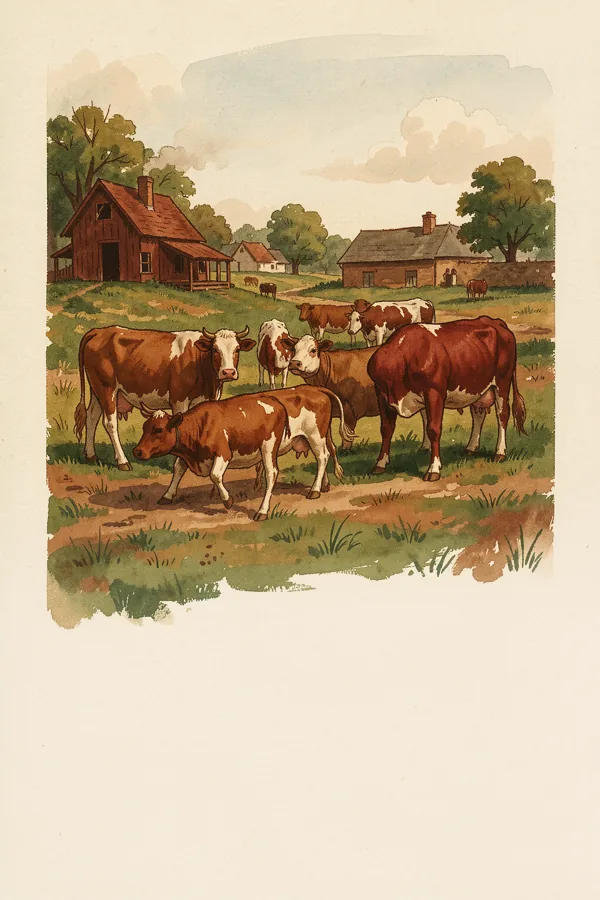
Cattle and Their Diseases is a nineteenth-century veterinary manual by Robert Jennings, a professor of veterinary medicine in Philadelphia. It covers the history and breeds of cattle, crossing and breeding, feeding and management, and then the diseases to which they are subject and the remedies of the day. It offers a window into early agricultural and veterinary knowledge.
For teachers and schools: paste the code into your site or blog.
Cover illustration generated by AI.
Text source: gutenberg.org · The work is in the public domain.
Opening of the book
Transcriber's Note: A number of typographical errors have been corrected. They are shown in the text with mouse-hover popups. CATTLE AND THEIR DISEASES EMBRACING THEIR HISTORY AND BREEDS, CROSSING AND BREEDING, AND FEEDING AND MANAGEMENT; WITH THE DISEASES TO WHICH THEY ARE SUBJECT, AND THE REMEDIES BEST ADAPTED TO THEIR CURE. TO WHICH IS ADDED A LIST OF THE MEDICINES USED IN TREATING CATTLE. BY ROBERT JENNINGS, V. S.,
PROFESSOR OF PATHOLOGY AND OPERATIVE SURGERY IN THE VETERINARY COLLEGE OF PHILADELPHIA; LATE PROFESSOR OF VETERINARY MEDICINE IN THE AGRICULTURAL COLLEGE OF OHIO; SECRETARY OF THE AMERICAN VETERINARY ASSOCIATION OF PHILADELPHIA; AUTHOR OF "THE HORSE AND HIS DISEASES," ETC., ETC. With Numerous Illustrations. PHILADELPHIA: John E. Potter and Company, 617 Sansom Street. Entered according to Act of Congress, in the year 1864, by JOHN E. POTTER, In the Clerk's Office of the District Court of the United States, in and for the Eastern District of Pennsylvania. PREFACE. A marked interest has of late years been manifested in our country relative to the subject of breeding and rearing domestic cattle. This has not been confined to the dairyman alone. The greater portion of intelligent agriculturists have perceived the necessity of paying more attention than was formerly devoted to the improvement and perfection of breeds for the uses of the table as well. In this respect, European cattle-raisers have long taken the
 Readnara