An Essay Concerning Humane Understanding by John Locke is a philosophical work in four books; this volume contains Books I and II. It examines the origins of human knowledge, argues against innate ideas, and develops an account of ideas from sensation and reflection. Listen for its clear, methodical prose and lasting influence on empiricism.
For teachers and schools: paste the code into your site or blog.
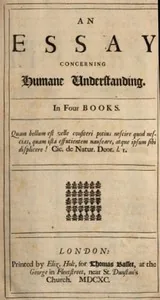
Cover of the original edition (Project Gutenberg, public domain).
Text source: gutenberg.org · The work is in the public domain.
Opening of the book
An Essay Concerning
Humane
Understanding
IN FOUR BOOKS
By John Locke
0001
Quam bellum est velle confiteri potius nescire quod nescias, quam ista effutientem nauseare, atque ipsum sibi displicere!
Cic. de Natur. Deor. l. 1.
LONDON:
Printed by Eliz. Holt, for Thomas Basset, at the George in Fleet Street, near St. Dunstan’s Church.
MDCXC
CONTENTS THE EPISTLE TO THE READER ESSAY CONCERNING HUMANE UNDERSTANDING. BOOK I NEITHER PRINCIPLES NOR IDEAS ARE INNATE CHAPTER I. INTRODUCTION. CHAPTER II. NO INNATE SPECULATIVE PRINCIPLES. CHAPTER III. NO INNATE PRACTICAL PRINCIPLES CHAPTER IV. OTHER CONSIDERATIONS CONCERNING INNATE PRINCIPLES, BOTH SPECULATIVE AND PRACTICAL. BOOK II OF IDEAS CHAPTER I. OF IDEAS IN GENERAL, AND THEIR ORIGINAL. CHAPTER II. OF SIMPLE IDEAS. CHAPTER III. OF SIMPLE IDEAS OF SENSE. CHAPTER IV. IDEA OF SOLIDITY. CHAPTER V. OF SIMPLE IDEAS OF DIVERS SENSES. CHAPTER VI. OF SIMPLE IDEAS OF REFLECTION. CHAPTER VII. OF SIMPLE IDEAS OF BOTH SENSATION AND REFLECTION. CHAPTER VIII. SOME FURTHER CONSIDERATIONS CONCERNING OUR SIMPLE IDEAS OF SENSATION. CHAPTER IX. OF PERCEPTION. CHAPTER X. OF RETENTION.
 Readnara