This volume gathers three of Cicero's philosophical dialogues: the Academic Questions, on knowledge and doubt; De Finibus, on the highest good and evil; and the Tusculan Disputations, on enduring life's hardships. A translation by C. D. Yonge, it offers a clear window into ancient Greek and Roman thought. Listeners interested in ethics and classical philosophy will find much to ponder.
For teachers and schools: paste the code into your site or blog.
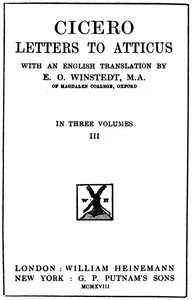
Cover of the original edition (Project Gutenberg, public domain).
Text source: gutenberg.org · The work is in the public domain.
Opening of the book
The Academic Questions, Treatise De Finibus. and Tusculan Disputations Of M. T. Cicero With A Sketch of the Greek Philosophers Mentioned by Cicero.
Literally Translated by C. D. Yonge, B.A. London: George Bell and Sons York Street Covent Garden Printed by William Clowes and Sons, Stamford Street and Charing Cross. 1875 Contents A Sketch of the Greek Philosophers Mentioned by Cicero. Introduction. First Book Of The Academic Questions. Second Book Of The Academic Questions. A Treatise On The Chief Good And Evil. First Book Of The Treatise On The Chief Good And Evil. Second Book Of The Treatise On The Chief Good And Evil. Third Book Of The Treatise On The Chief Good And Evil. Fourth Book Of The Treatise On The Chief Good And
Evil. Fifth Book Of The Treatise On The Chief Good And Evil. The Tusculan Disputations. Introduction. Book I. On The Contempt Of Death. Book II. On Bearing Pain. Book III. On Grief Of Mind. Book IV. On Other Perturbations Of The Mind. Book V. Whether Virtue Alone Be Sufficient For A Happy Life. Footnotes
[pg i]
A Sketch of the Greek
Philosophers Mentioned by
Cicero.
In the works translated in the present volume, Cicero makes such constant references to the doctrines and systems of the ancient Greek Philosophers, that it seems desirable to give a brief account of the most remarkable of those mentioned by him; not entering at length into the history of their lives, but indicating the principal theories which they maintained, and the main points in which they agreed with, or differed from, each other.
The earliest of them was Thales, who was born at Miletus, about 640 œ.ŕ. He was a man of great political sagacity and influence; but we have to consider him here as the earliest philosopher who appears to have been convinced of the necessity of scientific proof of whatever was put forward to be believed, and as the originator of mathematics and geometry. He was also a great
 Readnara