These are Cicero's personal letters to his friend Atticus, written in the final years of the Roman Republic. They mix politics, daily concerns, and private reflection, offering a firsthand view of public life after Caesar's civil victory. Volume three completes the collection for readers interested in history and ancient correspondence.
For teachers and schools: paste the code into your site or blog.
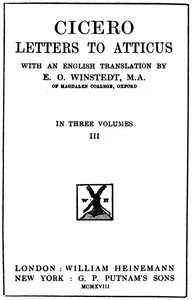
Cover of the original edition (Project Gutenberg, public domain).
Text source: gutenberg.org · The work is in the public domain.
Opening of the book
THE LOEB CLASSICAL LIBRARY EDITED BY E. CAPPS, Ph.D., LL.D. T. E. PAGE, Litt.D. W. H. D. ROUSE, Litt.D. LETTERS TO ATTICUS III CICERO'S LETTERS TO ATTICUS. Volume I. BOOKS I.-VI. Volume II. BOOKS VII.-XI. CICERO LETTERS TO ATTICUS WITH AN ENGLISH TRANSLATION BY E. O. WINSTEDT, M.A. OF MAGDALEN COLLEGE, OXFORD IN THREE VOLUMES III
LONDON: WILLIAM HEINEMANN NEW YORK: G. P. PUTNAM'S SONS MCMXVIII
INTRODUCTION
The letters contained in this volume begin with one written just after
Caesar's final victory over the remains of the Pompeian party at
Thapsus in April, 46 B.C., and cover three of the last four years of
Cicero's life. When they open, Cicero was enjoying a restful interval after the troublous times of the Civil War. He had made his peace with Caesar and reconciled himself to a life of retirement and literary activity. In the Senate he never spoke except to deliver a speech pleading for the return from exile of his friend Marcellus; and his only other public appearance was to advocate the cause of another friend,
Ligarius. In both he was successful; and, indeed, so he seems also to have been in private appeals to Caesar on behalf of friends. But their relations were never intimate,[1] and Cicero appears always to have felt ill at ease in Caesar's society,[2] disliking and fearing him as a possible tyrant or at least an anomaly in a Republican state. He evidently felt, too, some natural qualms at being too much of a turncoat, as he dissuaded his son from joining Caesar's expedition to Spain at the end of the year on that ground, and persuaded him to go to
Athens to study instead.[3] No doubt he considered that it was more consonant with the dignity which he was always claiming for himself to take no part in public affairs at all than to play a secondary part where he had once been first. Consequently he spent the year 46 peacefully engaged in writing and in his
 Readnara