Volume two of George Grote’s four-volume essays on Plato and the other companions of Sokrates. It examines dialogues such as Alkibiades I and II, where Sokrates questions Alkibiades’ political ambitions and his grasp of justice. A useful guide to Socratic method and Platonic thought.
For teachers and schools: paste the code into your site or blog.
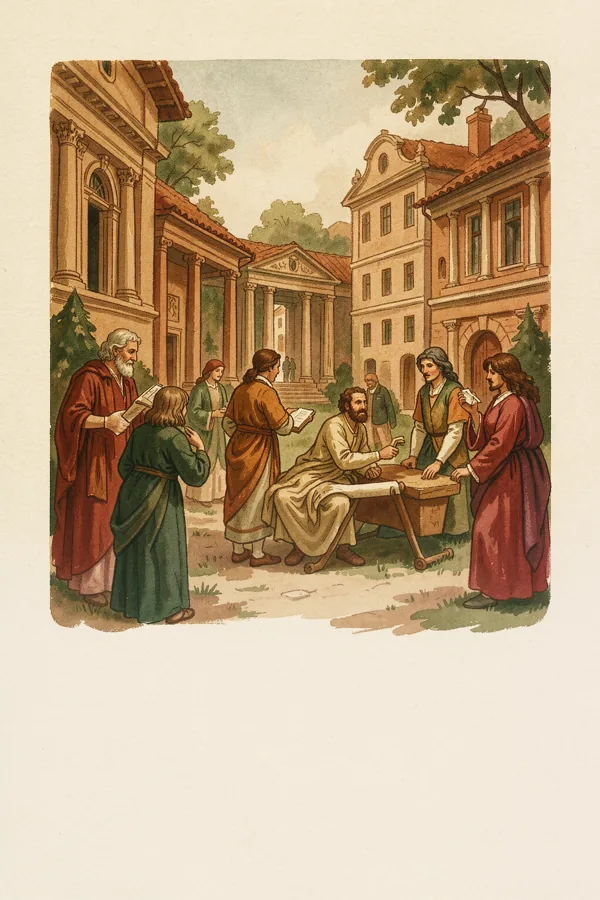
Cover illustration generated by AI.
Text source: gutenberg.org · The work is in the public domain.
Opening of the book
PLATO, AND THE OTHER COMPANIONS OF SOKRATES. PLATO, and the OTHER COMPANIONS OF SOKRATES. by GEORGE GROTE, author of the ‘history of greece’. A NEW EDITION. IN FOUR VOLUMES.
Vol. II. LONDON: JOHN MURRAY, ALBEMARLE STREET. 1888. The right of Translation is reserved. CONTENTS. CHAPTER XII. ALKIBIADES I. AND II. Situation supposed in the dialogue. Persons — Sokrates and Alkibiades 1 Exorbitant hopes and political ambition of Alkibiades 2
Questions put by Sokrates, in reference to Alkibiades in his intended function as adviser of the Athenians. What does he intend to advise them upon? What has he learnt, and what does he know? ib. Alkibiades intends to advise the Athenians on questions of war and peace. Questions of Sokrates thereupon. We must fight those whom it is better to fight — to what standard does better refer? To just and unjust 3 How, or from whom, has Alkibiades learnt to discern or distinguish Just and Unjust? He never learnt it from any one ; he always knew it, even as a boy 4 Answer amended. Alkibiades learnt it from the multitude, as he learnt to speak Greek. — The multitude cannot teach just and unjust, for they are at variance among themselves about it. Alkibiades is going to advise the Athenians about what he does not know himself 5
 Readnara