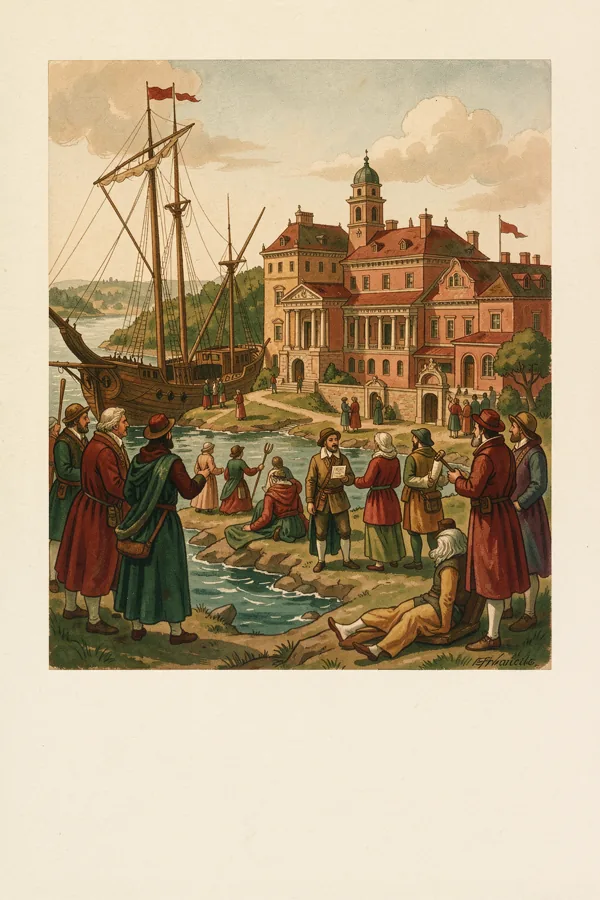
The New Atlantis is a short utopian tale and philosophical fragment by Francis Bacon, published after his death. It describes a ship's crew discovering the island of Bensalem, a peaceful and learned society, and its scientific college, Solomon's House. It is worth listening to as an early vision of organized research and a humane ideal commonwealth.
For teachers and schools: paste the code into your site or blog.
Cover illustration generated by AI.
Text source: gutenberg.org · The work is in the public domain.
Opening of the book
THE NEW ATLANTIS
BY
SIR FRANCIS BACON
INTRODUCTORY NOTE
Bacon's literary executor, Dr. Rowley, published "The New Atlantis" in
1627, the year after the author's death. It seems to have been written about
1623, during that period of literary activity which followed Bacon's political fall. None of Bacon's writings gives in short apace so vivid a picture of his tastes and aspirations as this fragment of the plan of an ideal commonwealth.
The generosity and enlightenment, the dignity and splendor, the piety and public spirit, of the inhabitants of Bensalem represent the ideal qualities which Bacon the statesman desired rather than hoped to see characteristic of his own country; and in Solomon's House we have Bacon the scientist indulging without restriction his prophetic vision of the future of human knowledge. No reader acquainted in any degree with the processes and results of modern scientific inquiry can fail to be struck by the numerous approximations made by Bacon's imagination to the actual achievements of modern times. The plan and organization of his great college lay down the main lines of the modern research university; and both in pure and applied science he anticipates a strikingly large number of recent inventions and discoveries. In still another way is "The New Atlantis" typical of Bacon's attitude. In spite of the enthusiastic and broad-minded schemes he laid down for the pursuit of truth, Bacon always had an eye to utility. The advancement of science which he sought was conceived by him as a means to a practical end the increase of man's control over nature, and the comfort and convenience of humanity. For pure metaphysics, or any form of abstract
 Readnara