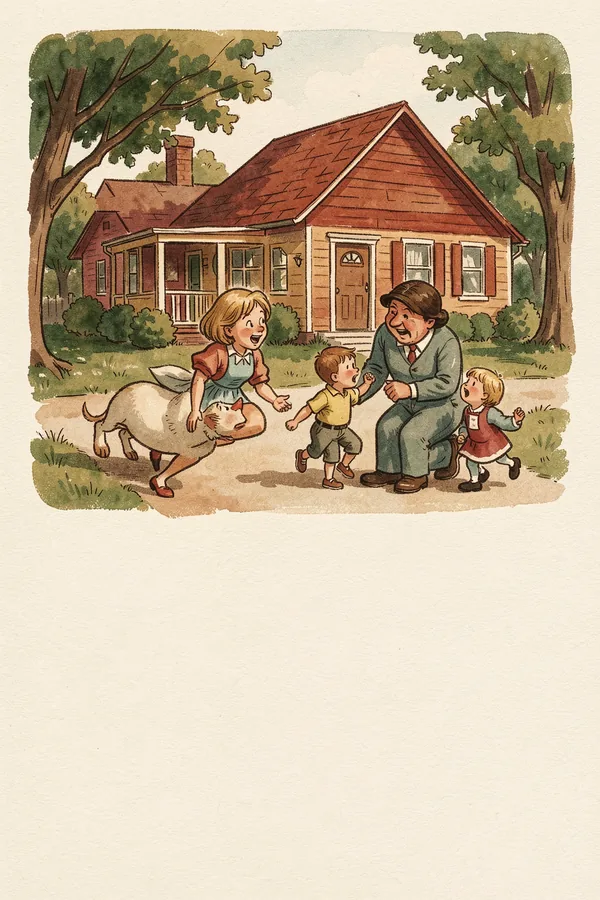
This fifth volume of Guy de Maupassant's works gathers his novel Une Vie (A Woman's Life) with several shorter stories. Une Vie traces a Norman woman's life from youth through marriage and later years; the stories turn on ordinary people, love, and moral weakness. Maupassant's plain, observant prose makes the collection rewarding to hear.
For teachers and schools: paste the code into your site or blog.
Cover illustration generated by AI.
Text source: gutenberg.org · The work is in the public domain.
Opening of the book
Transcriber's Notes 1. Inconsistencies in hyphenation have been maintained. 2. Several misprints and punctuation errors corrected. Hover over underlined word in the text to see the corrections made. A list of corrections can be found at the end of the text. The Works of Guy de Maupassant VOLUME V UNE VIE AND OTHER STORIES ILLUSTRATED NATIONAL LIBRARY COMPANY NEW YORK Copyright, 1909 By BIGELOW, SMITH & CO. CONTENTS Introduction A Woman's Life (Une Vie)
Hautot Senior and Hautot Junior Little Rouise Roqué Mother and Daughter A Passion No Quarter The Impolite Sex Woman's Wiles INTRODUCTION By Edmund Gosse The most robust and masculine of recent French novelists is a typical Norman, sprung from an ancient noble family, originally of Lorraine, but long settled in the Pays de Caux. The traveler from England towards Paris, soon after leaving Dieppe, sees on his left hand, immediately beyond the station of St. Aubin, a handsome sixteenth-century house, the Château de Miromesnil, on a hill above the railway. Here, surrounded by the relics of his warlike and courtly ancestors, Henri René Albert Guy de Maupassant was born on the 5th of August, 1850. He was early associated with the great Norman master of fiction, Gustave Flaubert, who perceived his genius and enthusiastically undertook the training of his intelligence. Through 1870 and 1871 the young man served in the war as a common soldier. He was somewhat slow in taking up the profession of letters, and was thirty years of age before he became in any degree distinguished. In 1879 the Troisième Théâtre Français produced a short play of his, Histoire du Vieux Temps (An Old-World Story), gracefully written in rhyme, but showing no very remarkable aptitude for the stage. It was in 1880 that De Maupassant was suddenly made famous by two published volumes. The one was a volume of Verses (Des Vers), twenty pieces, most of them of a narrative character, extremely brilliant in execution, and audacious
 Readnara