The Pictorial Field-Book of the Revolution, Vol. 2 (of 2) / or, Illustrations, by Pen And Pencil, of the History, Biography, Scenery, Relics, and Traditions of the War for Independence
Benson John Lossing
History
Book language: English
1569 pages
The second volume of Lossing's illustrated history of the American Revolution. It blends narrative, biography, and descriptions of scenery, relics, and local traditions, with hundreds of wood engravings. Listeners who enjoy nineteenth-century history and place-based detail will find it a vivid record of how the war for independence was remembered.
For teachers and schools: paste the code into your site or blog.
Cover of the original edition (Project Gutenberg, public domain).
Text source: gutenberg.org · The work is in the public domain.
Opening of the book
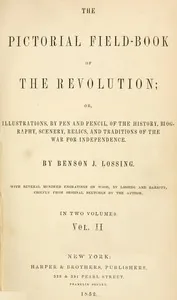
THE PICTORIAL FIELD-BOOK OF
THE REVOLUTION
Illustrations, By Pen And Pencil, Of The History, Biography,
Scenery, Relics, And Traditions Of The War For Independence.
By Benson J, Lossing,
With Several Hundred Engravings On Wood, By Lossing And Barritt, Chiefly
From Original Sketches By The Author.
Volume II (of II Volumes)
Harper & Brothers, Publishers,
1 8 5 2.
afrontispiecm
TRANSCRIBER'S NOTE:
Among the several challenging issues with this two volume set were: 1. The duplication of the last eight chapters of Volume I. inserted at the beginning of Volume II.; and there given chapter numbers starting with Chapter I". 2. That the index in Volume I did not include any references to the last eight chapters. The index references to these duplicated chapters were however include in Volume II. 3. Spelling of many words and names in both volumes was inventive and variable from one paragraph to another. In proofing this file I began to believe the printer was short of "e's c's and o's" and began to substitute one for the others. I am sure I missed many of these. 4. The grammar used was often unacceptable today. 5. Nearly every page had long footnotes in extremely small print. Some of the footnotes referred to other footnotes. Many of the longer footnotes and footnotes to footnotes were placed at the bottom of succeeding pages, making the organization of these to the bottom of the page referring to them was challenging. 6. The extremely small and blurred print was often beyond the ability of the best Optical Character Recognition program available. Volume I. CONTENTS
 Readnara