The Orbis Pictus is a 17th-century illustrated children's textbook by Jan Amos Comenius. It teaches language and basic knowledge through pictures and short parallel texts about the natural world, trades, and daily life. It is worth listening to as a historical introduction to early modern education and the idea of learning through images.
For teachers and schools: paste the code into your site or blog.
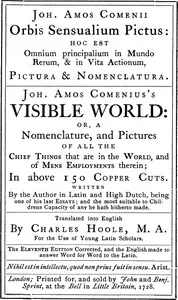
Cover of the original edition (Project Gutenberg, public domain).
Text source: gutenberg.org · The work is in the public domain.
Opening of the book
This text includes characters that require UTF-8 (Unicode) file encoding: œ [oe ligature, used in all Latin text]
☉ ♂ ♈ ... [astrological symbols: see below]
If any of these characters do not display properly—in particular, if the diacritic does not appear directly above the letter—or if the apostrophes and quotation marks in this paragraph appear as garbage, you may have an incompatible browser or unavailable fonts. First, make sure that the browser’s “character set” or “file encoding” is set to Unicode (UTF-8). You may also need to change your browser’s default font.
The two sections numbered CIV use astrological symbols. Most are accompanied by a definition, so the meaning will be plain even if your browser cannot display them. When a symbol is used in place of a word, its meaning is shown in a popup: ☉.
Typographical errors are shown in the text with mouse-hover popups. In the Orbis Pictus text, apparent errors in punctuation and typography (such as Italic type where Roman is expected) were unchanged except in chapter headers, where readers may need the exact format for text searches. Uncorrected errors are noted with popups. Note that “Dutch” generally means “German”.
Line breaks are approximately but not exactly the same as in the original.
 Readnara