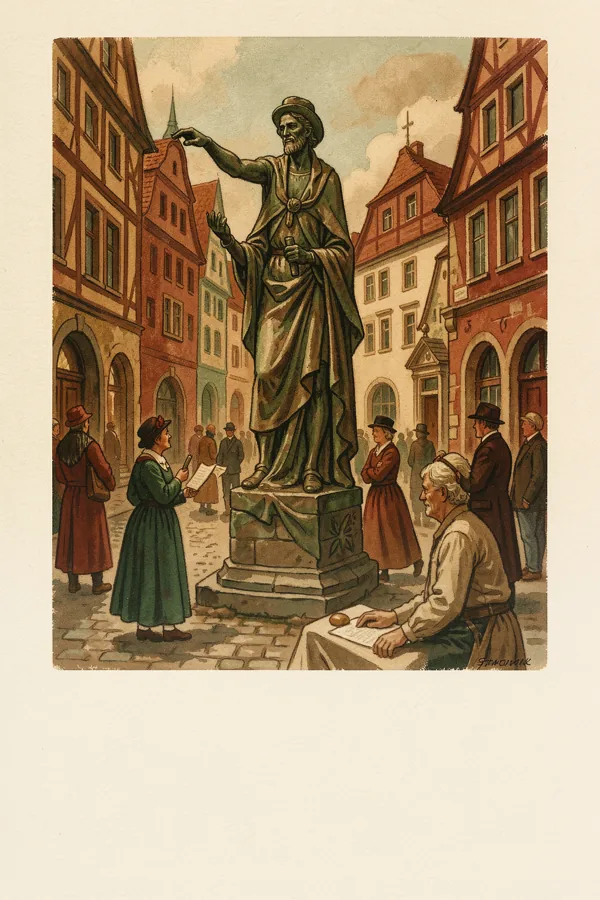
The Goose Man (Das Gänsemännchen) is a novel by Jakob Wassermann, named after the famous statue in Nuremberg. It follows an artist's inner life and struggles in a richly drawn old German setting. It is worth listening to for its psychological depth and atmospheric portrayal of ambition and relationships.
For teachers and schools: paste the code into your site or blog.
Cover illustration generated by AI.
Text source: gutenberg.org · The work is in the public domain.
Opening of the book
The GOOSE MAN by Jacob Wassermann Author of “THE WORLD’S ILLUSION” Authorized translation by ALLEN W. PORTERFIELD Das Gänsemännchen GROSSET & DUNLAP ~ Publishers by arrangement with HARCOURT, BRACE & COMPANY NOTE The first chapter, “A Mother Seeks Her Son,” and sections I and II of the second chapter, “Foes, Brothers, a Friend, and a Mask,” were translated by Ludwig Lewisohn. The rest of the book has been translated by Allen W. Porterfield. The title, “The Goose Man” (“Das Gänsemännchen”), refers to the famous statue of that name in Nuremberg. COPYRIGHT, 1922, BY HARCOURT, BRACE AND COMPANY, INC. PRINTED IN THE U. S. A.
PAGE A Mother Seeks Her Son 1 Foes, Brothers, A Friend and a Mask 23 The Nero of To-day 44 Inspector Jordan and His Children 65 Voices from Without and Voices from Within 97 In Memory of a Dream Figure 123 Daniel and Gertrude 153 The Glass Case Breaks 178 Tres Faciunt Collegium 204 Philippina Starts a Fire 239 Eleanore 277 The Room with the Withered Flowers 323 The Promethean Symphony 352 Dorothea 405 The Devil Leaves the House in Flames 435 But Aside, Who Is It? 455 CONTENTS THE GOOSE MAN
 Readnara