Opening of the book
Al-Fatihah
In the Khedivial Library of Cairo, among the Papyri of the Scribe of
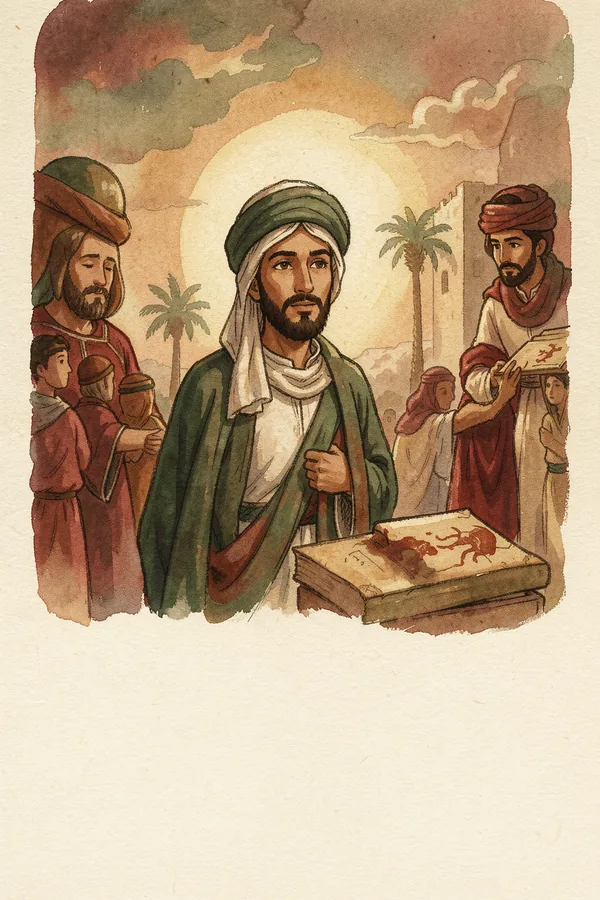
Amen-Ra and the beautifully illuminated copies of the Koran, the modern Arabic Manuscript which forms the subject of this Book, was found. The present Editor was attracted to it by the dedication and the rough drawings on the cover; which, indeed, are as curious, if not as mystical, as ancient Egyptian symbols. One of these is supposed to represent a New York Skyscraper in the shape of a Pyramid, the other is a dancing group under which is written: “The
Stockbrokers and the Dervishes.” And around these symbols, in Arabic circlewise, these words: —“And this is my Book, the Book of
Khalid, which I dedicate to my Brother Man, my Mother Nature, and my Maker God.”
Needless to say we asked at once the Custodian of the Library to give us access to this Book of Khalid, and after examining it, we hired an amanuensis to make a copy for us. Which copy we subsequently used as the warp of our material; the woof we shall speak of in the following chapter. No, there is nothing in this Work which we can call ours, except it be the Loom. But the weaving, we assure the Reader, was a mortal process; for the material is of such a mixture that here and there the raw silk of Syria is often spun with the cotton and wool of America. In other words, the Author dips his antique pen in a modern inkstand, and when the ink runs thick, he mixes it with a slabbering of slang. But we started to write an Introduction, not a Criticism. And lest we end by writing neither, we give here what is more to the point than anything we can say: namely, al-Fatihah, or the Opening Word of Khalid himself.
With supreme indifference to the classic Arabic proem, he begins by saying that his Book is neither a Memoir nor an Autobiography, neither a Journal nor a Confession.
“Orientals,” says he, “seldom adventure into that region of fancy and fabrication so alluring to European and American writers; for,
Keep listening free
 Readnara