The Bābur-nāma is the memoir of Ẓahīr al-Dīn Muḥammad Bābur, founder of the Mughal Empire. Written in Chagatai Turkic and translated by Annette Beveridge, it recounts his campaigns, rulers, lands, and daily life across Central Asia and India. It offers a rare firsthand view of a ruler and his world.
For teachers and schools: paste the code into your site or blog.
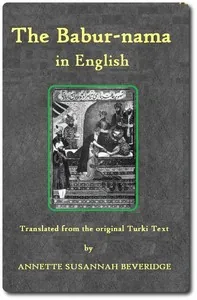
Cover of the original edition (Project Gutenberg, public domain).
Text source: gutenberg.org · The work is in the public domain.
Opening of the book
The Bābur-nāma in English (Memoirs of Bābur) Translated from the original Turki Text OF Z̤ahiru’d-dīn Muḥammad Bābur Pādshāh Ghāzī BY ANNETTE SUSANNAH BEVERIDGE First Printed 1922 This work is dedicate to Bābur’s fame. TABLE OF CONTENTS
Pǡŧżĵŕŧ: Introductory.—Cap. I. Babur’s exemplars in the Arts of peace, p. xxvii.—Cap. II. Problems of the mutilated Baburnama, p. xxxi.—Cap. III. The Turki MSS. and work connecting with them, p. xxxviii.—Cap. IV. The Leyden and
Erskine “Memoirs of Baber”, p. lvii.—Postscript of Thanks, p. lx.
SECTION I.—FARGHĀNA
899 AH.—Oct. 12th 1493 to Oct. 2nd 1494 AD.—Bābur’s age at the date of his accession—Description of Farghāna (pp. 1 to 12)—Death and biography of ‘Umar Shaikh (13 to 19 and
24 to 28)—Biography of Yūnas Chaghatāī (18 to 24)—
Bābur’s uncles Aḥmad Mīrān-shāhī and Maḥmūd Chaghatāī
(The Khān) invade Farghāna—Death and biography of
Aḥmad—Misdoings of his successor, his brother Maḥmūd
1-42
900 AH.—Oct. 2nd 1494 to Sep. 21st 1495 AD.—Invasion of
Farghāna
continued—Bābur’s
adoption
of
orthodox
observance—Death and biography of Maḥmūd Mīrān-shāhī
—Samarkand affairs—revolt of Ibrāhīm Sārū defeated—
Bābur visits The Khān in Tāshkīnt—tribute collected from the Jīgrak tribe—expedition into Aūrātīpā
43-56
901 AH.—Sep. 21st 1495 to Sep. 9th 1496 AD.—Ḥusain Bāīqarā’s campaign against Khusrau Shāh—Bābur receives
Aūzbeg sult̤āns—Revolt of the Tarkhāns in Samarkand—
Bābur’s first move for Samarkand
57-64
902 AH.—Sep. 9th 1496 to Aug. 30th 1497 AD.—Bābur’s second move for Samarkand—Dissensions of Ḥusain Bāī-qarā and his sons—Dissensions between Khusrau Shāh and Mas‘ūd
 Readnara