The $30,000 Bequest, and Other Stories is a collection of short fiction by Mark Twain. Its title story follows a modest small-town bookkeeper and his wife as news of a bequest stirs their dreams and schemes. The other pieces show Twain's humor and keen eye for human nature, making the collection rewarding to read or listen to.
For teachers and schools: paste the code into your site or blog.
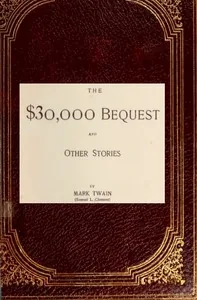
Cover of the original edition (Project Gutenberg, public domain).
Text source: gutenberg.org · The work is in the public domain.
Opening of the book
THE $30,000 BEQUEST and Other Stories by Mark Twain (Samuel L. Clemens) 0006
THE $30,000 BEQUEST
CHAPTER I
Lakeside was a pleasant little town of five or six thousand inhabitants, and a rather pretty one, too, as towns go in the Far West.
It had church accommodations for thirty-five thousand, which is the way of the Far West and the South, where everybody is religious, and where each of the Protestant sects is represented and has a plant of its own. Rank was unknown in Lakeside—unconfessed, anyway; everybody knew everybody and his dog, and a sociable friendliness was the prevailing atmosphere.
Saladin Foster was book-keeper in the principal store, and the only high-salaried man of his profession in Lakeside. He was thirty-five years old, now; he had served that store for fourteen years; he had begun in his marriage-week at four hundred dollars a year, and had climbed steadily up, a hundred dollars a year, for four years; from that time forth his wage had remained eight hundred—a handsome figure indeed, and everybody conceded that he was worth it.
His wife, Electra, was a capable helpmeet, although—like himself— a dreamer of dreams and a private dabbler in romance. The first thing she did, after her marriage—child as she was, aged only nineteen— was to buy an acre of ground on the edge of the town, and pay down the cash for it—twenty-five dollars, all her fortune. Saladin had less, by fifteen. She instituted a vegetable garden there, got it farmed on shares by the nearest neighbor, and made it pay her a hundred per
 Readnara