Priscilla's Spies is a 1912 novel by George A. Birmingham. It opens in a boys' school with Frank Mannix's cricketing triumph, while the title introduces Priscilla and a story of spies. A light, character-driven novel of school life and intrigue, it is an easy, enjoyable listen.
For teachers and schools: paste the code into your site or blog.
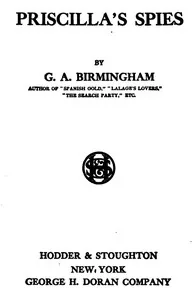
Cover of the original edition (Project Gutenberg, public domain).
Text source: gutenberg.org · The work is in the public domain.
Opening of the book
PRISCILLA’S SPIES By George A. Birmingham Copyright, 1912, By George H. Doran Company map-frontispiece (129K) To M. E. M., M. S. R., D. P., and L. K. The vision of whose tents I have panned about the bay.
PRISCILLA’S SPIES CHAPTER I The summer term ended in a blaze of glory for Frank Mannix. It was a generally accepted opinion in the school that his brilliant catch in the long field—a catch which disposed of the Uppingham captain—had been the decisive factor in winning the most important of matches. And the victory was particularly gratifying, for Haileybury had been defeated for five years previously. There was no doubt at all that the sixty not out made by Mannix in the first innings rendered victory possible in the “cock house” match, and that his performance as a bowler, first change, in the second innings, secured the coveted trophy, a silver cup, for Edmonstone House. These feats were duly recorded by Mr. Dupré, the house master, in a neat speech which he made at a feast given in the classroom to celebrate the glory of the house. When the plates of the eleven were finally cleared of cherry tart and tumblers were refilled with the most innocuous claret cup, Mr. Dupré rose to his feet. He chronicled the virtues and successes of the hero of the hour. The catch in the Uppingham match was touched on— a dangerous bat that Uppingham captain. The sixty not out in the house match had been rewarded with a presentation bat bearing a silver shield on the back of it. No boy in the house, so Mr. Dupré said, grudged the sixpence which had been stopped from his pocket money to pay for the bat. Then, passing to graver matters, Mr. Dupré spoke warmly of the tone of the house, that indefinable quality which in the eyes of a faithful schoolmaster is more precious than rubies. It was Mannix, prefect and member of the lower
 Readnara