Madame Bovary is a realist novel by Gustave Flaubert about Emma, a country doctor's wife whose romantic dreams clash with provincial married life. Through precise, unsentimental prose it portrays longing, illusion and the quiet pressures of ordinary existence. It is worth listening for its psychological depth and its influence on the modern novel.
For teachers and schools: paste the code into your site or blog.
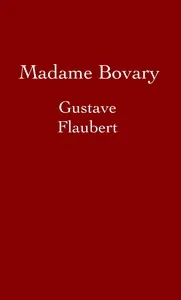
Cover of the original edition (Project Gutenberg, public domain).
Text source: gutenberg.org · The work is in the public domain.
Opening of the book
Madame Bovary By Gustave Flaubert Translated from the French by Eleanor Marx-Aveling
To
Marie-Antoine-Jules Senard
Member of the Paris Bar, Ex-President of the National Assembly, and
Former Minister of the Interior
Dear and Illustrious Friend,
Permit me to inscribe your name at the head of this book, and above its dedication; for it is to you, before all, that I owe its publication. Reading over your magnificent defence, my work has acquired for myself, as it were, an unexpected authority.
Accept, then, here, the homage of my gratitude, which, how great soever it is, will never attain the height of your eloquence and your devotion.
Gustave Flaubert,
Paris, 12 April 1857
Contents PART I. Chapter One Chapter Two Chapter Three Chapter Four Chapter Five Chapter Six Chapter Seven Chapter Eight Chapter Nine PART II. Chapter One Chapter Two Chapter Three Chapter Four Chapter Five Chapter Six Chapter Seven Chapter Eight Chapter Nine Chapter Ten
Chapter Eleven Chapter Twelve Chapter Thirteen Chapter Fourteen Chapter Fifteen PART III. Chapter One Chapter Two Chapter Three Chapter Four Chapter Five Chapter Six Chapter Seven Chapter Eight Chapter Nine Chapter Ten Chapter Eleven
 Readnara