Electricity for Boys by James Slough Zerbe is a 1914 instructional children's book, a hands-on guide to early electrical experiments and apparatus. It explains tools, magnets, coils, and basic electrical principles through period illustrations. It is a historical snapshot of how young readers once encountered electricity, with the caution that its experiments are now considered dangerous.
For teachers and schools: paste the code into your site or blog.
Cover illustration generated by AI.
Text source: gutenberg.org · The work is in the public domain.
Opening of the book
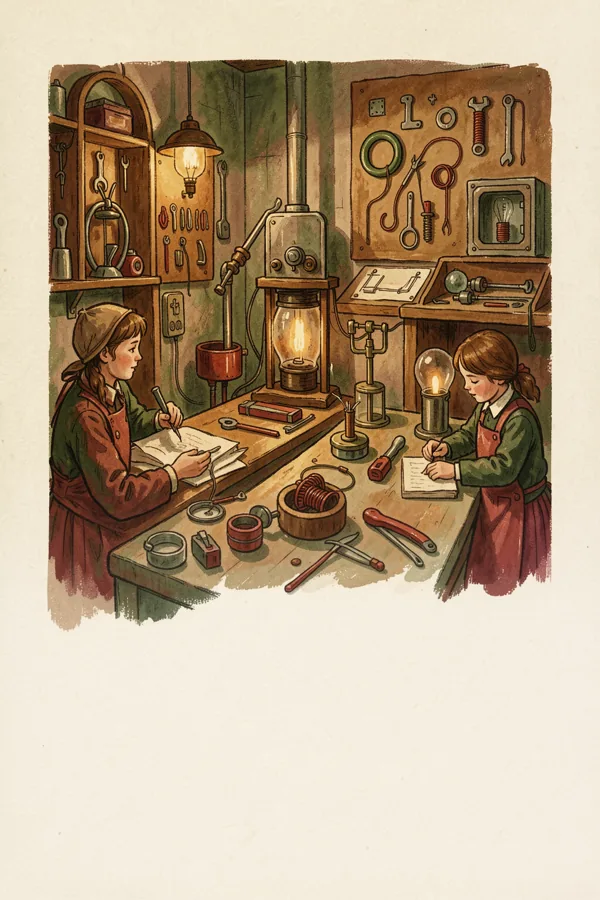
WARNING: This book of one hundred years ago describes experiments which are too dangerous to attempt by either adults or children. It is published for historical interest only. The "How-to-do-it" Books ELECTRICITY FOR BOYS Fig. 1. WORK BENCH Fig. 1. WORK BENCH
THE "HOW-TO-DO-IT" BOOKS ELECTRICITY FOR BOYS A working guide, in the successive steps of electricity, described in simple terms WITH MANY ORIGINAL ILLUSTRATIONS By J. S. ZERBE, M.E. AUTHOR OF CARPENTRY FOR BOYSPRACTICAL MECHANICS FOR BOYS Printer's Mark: NYBC/Windmill THE NEW YORK BOOK COMPANY New York Copyright, 1914, by THE NEW YORK BOOK COMPANY p. i CONTENTS Introductory Page 1
I. Electricity Considered. Brief Historical Events Page 5 The Study of Electricity. First Historical Accounts. Bottling Electricity. Discovery of Galvanic Electricity. Electro-motive Force. Measuring Instruments. Rapidity of Modern Progress. How to Acquire the Vast Knowledge. The Means Employed. II. What Tools and Apparatus are Needed Page 11 Preparing the Workshop. Uses of Our Workshop. What to Build. What to Learn. Uses of the Electrical Devices. Tools. Magnet-winding Reel. III. Magnets, Coils, Armatures, Etc. Page 18 The Two Kinds of Magnets. Permanent Magnets. Electro-Magnets. Magnetism. Materials for Magnets. Non-magnetic Material. Action of a Second Magnet. What North and South Pole Mean. Repulsion and Attraction. Positives and Negatives. Magnetic Lines of Force. The Earth as a Magnet. Why the Compass Points North and South. Peculiarity of a Magnet. Action of the Electro-Magnet. Exterior Magnetic Influence Around a Wires Carrying a Current. Parallel Wires.
 Readnara