Charles Creighton's scholarly history of epidemics in Britain, first published in 1891. It traces pestilences from the first recorded outbreak in 664 to the disappearance of plague after 1665, drawing on contemporary chronicles and medical records. It offers a detailed view of how disease shaped daily life and public responses across centuries.
For teachers and schools: paste the code into your site or blog.
Cover of the original edition (Project Gutenberg, public domain).
Text source: gutenberg.org · The work is in the public domain.
Opening of the book
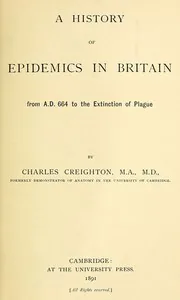
A HISTORY OF EPIDEMICS IN BRITAIN. London: C. J. CLAY ĵƿŠ SONS, CAMBRIDGE UNIVERSITY PRESS WAREHOUSE, AND H. K. LEWIS, 136, GOWER STREET, W.C. Cambridge: DEIGHTON, BELL AND CO. Leipzig: F. A. BROCKHAUS. New York: MACMILLAN AND CO. A HISTORY OF EPIDEMICS IN BRITAIN from A.D. 664 to the Extinction of Plague BY
CHARLES CREIGHTON, M.A., M.D.,
FORMERLY DEMONSTRATOR OF ANATOMY IN THE UNIVERSITY OF CAMBRIDGE.
CAMBRIDGE:
AT THE UNIVERSITY PRESS.
1891
[All rights reserved.]
Cambridge:
PRINTED BY C. J. CLAY, M.A. AND SONS,
AT THE UNIVERSITY PRESS.
PREFACE.
The title and contents-table of this volume will show sufficiently its scope, and a glance at the references in the several chapters will show its sources. But it may be convenient to premise a few general remarks under each of those heads. The date 664 A.D. has been chosen as a starting-point, for the reason that it is the year of the first pestilence in Britain recorded on contemporary or almost contemporary authority, that of Beda’s ‘Ecclesiastical History.’ The other limit of the volume, the extinction of plague in 1665-66, marks the end of a long era of epidemic sickness, which differed much in character from the era next following. At or near the Restoration we come, as it were, to the opening of a new seal or the outpouring of another vial. The history proceeds thenceforth on other lines and comes largely from sources of another kind; allowing for a little overlapping about the middle of the seventeenth century, it might be continued from 1666
 Readnara